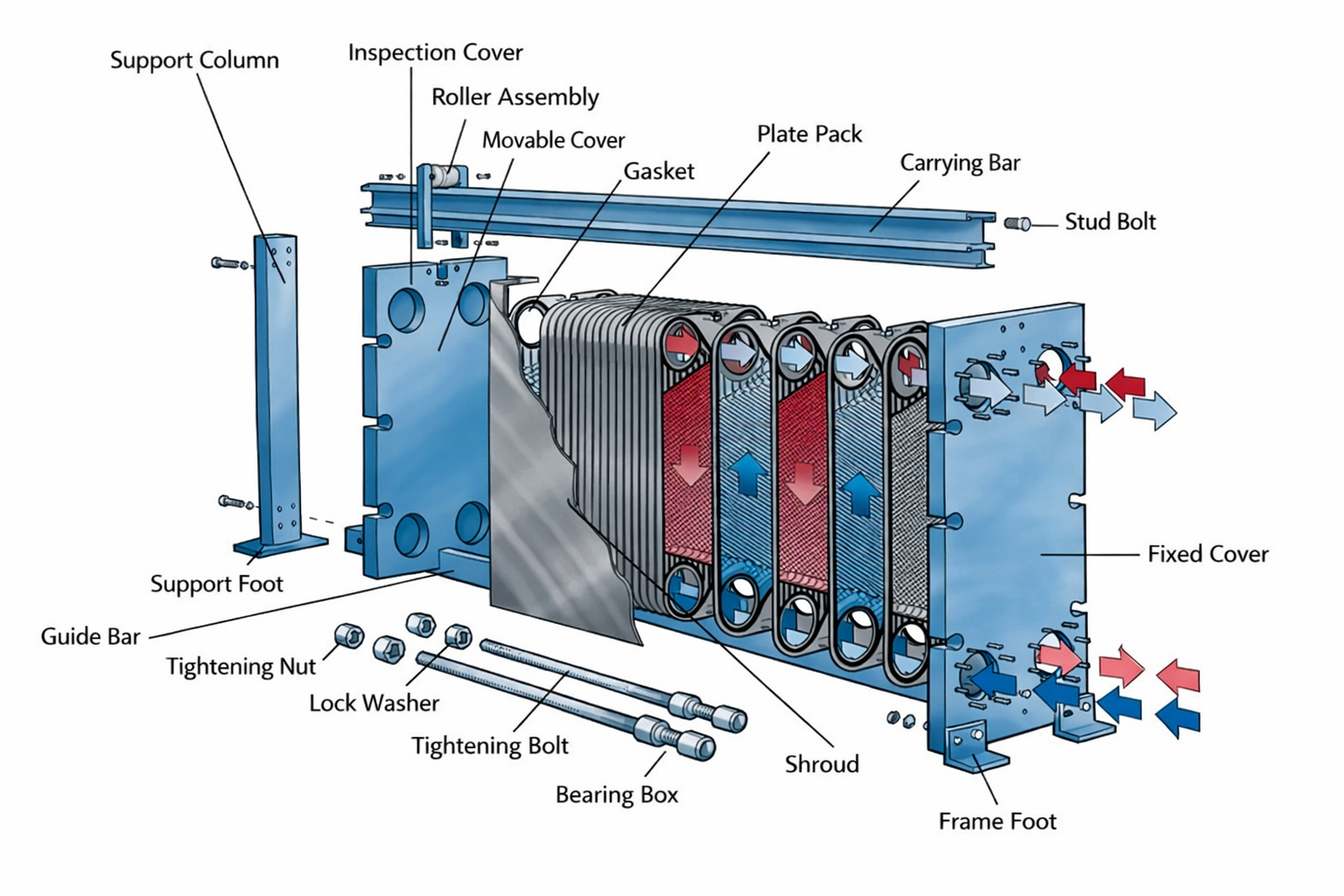
A well-maintained heat exchanger protects product quality, energy efficiency, and uptime. In hygienic processing, minor maintenance errors can quickly turn into costly failures. Overpressure can blow out a gasket. Incorrect cleaning chemistry can degrade elastomers. Rushed reassembly can distort a plate pack or damage the frame.
This guide explains what actually fails in the field in plate-and-frame heat exchangers, why those failures happen, and what plants can do to prevent them. First, it draws on field service experience to outline the most common problems with gaskets, plates, and frames. Next, it examines CIP procedures and installation practices, concluding with practical recommendations to extend service life and reduce unplanned downtime.
What Are the Most Common Heat Exchanger Failures in the Field?
The most common plate heat exchanger failures in hygienic service include:
Gasket blowouts and chemical degradation
Plate fatigue, cracking, and corrosion pitting
Frame distortion from uneven tightening or impact
CIP-related damage from incorrect chemistry, temperature, or rinsing
Installation and startup mistakes, such as improper compression or water hammer
These failure modes generally stem from controllable factors. Understanding how maintenance practices, chemical compatibility, startup procedures, and assembly contribute allows plants to proactively address them before unplanned downtime occurs. The next section focuses on gasket failures, the most common and costly issue.
Gasket Failure Patterns in Plate-and-Frame Heat Exchangers
What Causes Gaskets to Fail Most Often?
The two most common gasket failure drivers are:
Overpressurizing the unit beyond its maximum allowable working pressure
Using elastomers that are incompatible with the process fluid or cleaning chemistry
Overpressurizing a plate heat exchanger can force the gasket out of its groove or tear it, making reuse impossible. Blowouts may deform both the gasket and plate, warranting inspection of both.
Elastomer selection must precisely match the process media and the CIP program. For example, EPDM is suitable for steam and acid, but breaks down in oils and fats, making it unsuitable for high-fat foods like cream or vegetable oil.
Used or repurposed equipment is especially vulnerable here. A unit can be returned to service with the wrong gasket material for the application, leading to rapid degradation and premature failure.
"The two most common gasket failure paths are overpressurizing the units beyond the maximum allowable working pressure and incompatible chemical exposure." - Ryan Frank
What Typically Causes Gasket Blowouts?
Common causes of gasket blowout include:
Pressure spikes and water hammer
Frozen product or fluid in the unit
Gaskets that were rolled, pinched, or mis-seated during assembly
Chemical degradation that reduces elasticity and holding strength
Assembly quality matters. Gasket misalignment during reassembly becomes a weak point that often fails first under overpressure.
How Does Reassembly Affect Gasket Life?
Plate-and-frame heat exchangers must be tightened to a specific A dimension based on plate geometry, gasket, and plate count—not a set torque.
Correct tightening is one of the most important parts of heat exchanger maintenance. Best practice includes:
Tightening slowly
Using a star-pattern sequence
Moving between bolts frequently
Keeping the plate pack aligned throughout the process
Staying within the manufacturer's allowable A-dimension range
Uneven or overly quick tightening causes gaskets to slip, plates to misalign, and frame damage. A slipped gasket may require replacement before the exchanger resumes service.
Under-tightening can also create problems. As gaskets age, some units require re-tightening over time. As long as the frame is tightened evenly and slowly within allowable tolerances, this is acceptable.
What Cleaning Chemicals Shorten Gasket Life?
All common CIP chemicals place some degree of stress on elastomers. Whether that stress becomes damaging depends heavily on concentration and temperature.
EPDM and NBR can tolerate common caustic and acid cleaners at proper concentrations and temperatures. Raising the concentration or temperature unnecessarily can quickly become damaging.
A common mistake in the field is assuming that increased chemical concentration and higher temperatures always improve cleaning. In reality, that approach can:
Shorten gasket life
Accelerate plate damage
Reduce long-term reliability
Create cleaning conditions that are harsher than necessary.
How Can Plants Extend Gasket Life?
Plants can extend gasket life by focusing on four fundamentals:
Select the correct elastomer for the product and CIP chemistry.
Ensure gaskets are seated correctly during assembly.
Avoid over-tightening the plate pack.
Standardize and consistently follow CIP procedures.
Early Warning Signs of Gasket Failure
Operators often miss early indicators such as:
Weeping or leakage at ports or plate edges
Bulging elastomer visible outside the plate pack. Softened, swollen, or brittle gasket material after cleaning
Repeated need for re-tightening
Leaks that appear after a CIP cycle
"Most gasket failures aren't material problems — they're installation or chemical compatibility issues." - Ryan Frank
What Causes Plate Fatigue Over Time?
Plate cracking results from repeated thermal and physical stress cycles—every startup, shutdown, or CIP event flexes plates. Thousands of cycles concentrate dislocations in the metal's molecular lattice structure, and can lead to crack propagation.
In hygienic service, this can happen faster than in lower-stress applications like HVAC because process conditions are often more aggressive. Many food and beverage systems cycle frequently, exposing plates to wide temperature differentials, hot and cold fluids, and repeated startup events.
Fatigue can also be accelerated by corrosion. Chlorides, aggressive acids, and poor chemical control can create pits in the plate surface. Those pits act as stress concentrators, increasing the likelihood of cracking.
How Do Pressure Fluctuations Lead to Microcracking?
Pressure fluctuations flex the plates repeatedly, eventually causing metal fatigue and cracking, similar to bending a paperclip until it breaks.
Operational stability is critical. Pressure spikes, water hammer, and sudden changes rapidly increase the risk of fatigue-related cracking.
What Signs Show Plates Are Nearing the End of Life?
Some warning signs are visible. Others are not.
Visible indicators include:
Corrosion pitting
Crevice attack
Surface irregularities or staining linked to corrosion
Cracking is often invisible until it becomes severe. Preventive inspection is vital. Reusing older plates requires chemical cleaning, professional re-gasketing, and approved testing.
Gas integrity testing predicts future plate failure
Plates are chemically cleaned and tested with penetrative dye
Re-gasketed with OEM elastomers and stored for future use
Plate Failure FAQs
Can Cleaning Frequency Accelerate Plate Fatigue?
Cleaning frequency, by itself, is usually not the problem. Fatigue increases when cleaning is done incorrectly.
Plate damage is more likely when CIP involves:
Excessive temperatures
Overly aggressive chemical concentrations
Flow rates outside the manufacturer’s recommended range
Repeated thermal shock from poor ramping practices
Which Fluids Are Especially Aggressive on Plates?
Chlorides and salty fluids are especially hard on stainless steel plates. Examples include:
Hot brines
Soy sauce
Electrolyte beverages
These services often require specialty alloys rather than standard stainless steel to achieve acceptable service life.
What Is the Most Common Mistake When Reusing Older Plates?
Older plates can often be reused successfully, but only if they are properly refurbished and inspected. A common mistake is mixing older plates into a plate pack without:
Proper chemical cleaning
Leak or crack testing
Professional re-gasketing
Verification that the elastomer materials match
Frame Damage and Structural Failure FAQs
What Types of Frame Damage Are Most Common in the Field?
Frame damage is commonly caused by:
Corrosion from chemical exposure, steam, or standing water
Exposure to incompatible process fluids
Compromised stainless cladding over carbon steel
Pressure spikes and overpressurization
Thermal shock
Excessive vibration
Physical impact, including forklift damage
In many hygienic frames, stainless cladding over carbon steel can crack. Moisture beneath causes rust, swelling, and distortion, weakening alignment and sealing.
How Does Uneven Tightening Affect the Frame?
Uneven tightening does not just harm gaskets and plates; it also harms the components they support. It can also damage the frame itself.
If the pressure plate is closed unevenly, it can plastically deform. Once that happens, the damage is usually permanent, and sealing reliability may be compromised.
What Causes Frame Warping or Distortion?
Common causes include:
Uneven closure
Pressure spikes
Water hammer
Thermal shock
Excessive vibration
Chemical attack
Impact damage
How Can Operators Spot Early Frame Problems?
Signs of developing frame issues include:
A “snaking” plate pack with visible misalignment
Ports that appear to be under tension
Corrosion, pitting, or rust on frame members
Discoloration near welds or port locations
Repeated alignment issues during opening and closing
Can Damaged Frames Be Repaired?
In most cases, damaged frame components should be replaced rather than patched. The frame design helps determine the unit’s pressure rating. Once a structural component is compromised, informal repairs can raise safety and reliability concerns.
Improper CIP Damage FAQs
What Flow Velocities Are Too Low or Too High?
Low CIP flow rates are problematic because they do not clean effectively. High flow rates can create physical damage, including:
Plate erosion
Vibration
Excessive plate flexing
Gasket damage
The correct flow rate should always be determined by the equipment manufacturer’s recommendations for that exchanger design.
What CIP Mistakes Damage Heat Exchangers Most Frequently?
The most common CIP mistakes are:
Using an incorrect chemical composition
Running cleaning solutions hotter than necessary
Using excessive chemical concentration
Leaving cleaning chemicals in contact for too long
Failing to rinse adequately between steps
One of the most damaging mistakes is moving directly from a caustic step to an acid step without thoroughly rinsing. The chemicals react with each other, producing gas and precipitated byproducts while also reducing cleaning effectiveness.
How Does Improper Temperature Ramping Affect Equipment?
Rapid temperature changes create thermal stress in plates, gaskets, and other components. In many cases, large temperature swings are more damaging than operators expect.
Steam, hot caustic, chilled media, and rapid transitions between hot and cold cycles should all be introduced carefully to avoid thermal shock.
What Happens When Cleaning Chemistry Is Not Compatible With Materials?
When cleaning chemistry is incompatible with elastomers or metal alloys, those materials degrade. That can lead to:
Gasket softening, swelling, or embrittlement
Corrosion of plates
Reduced seal integrity
Early component failure
How Does Improper Piping Alignment Affect Longevity?
Improper piping alignment can place mechanical loads on the exchanger nozzles and frame. Over time, these stresses can contribute to distortion, leakage, and alignment issues during maintenance. Proper pipe support and alignment reduce unnecessary structural stress on the unit.
How Important Is Startup Ramp Protocol?
The startup ramp protocol is critical.
Rapid flooding can cause water hammer, which can blow out gaskets or damage plates. Rapid temperature swings also create avoidable stress in gaskets, plates, and frames. Controlled ramping of both pressure and temperature helps prevent many common field failures.
What Is the Biggest Preventable Failure in the Field?
The biggest preventable failures usually fall into two categories:
Improper CIP practices
Incorrect plate-pack compression during reassembly
Both are fully within plant control, and both have an outsized effect on reliability.
If You Could Give Plant Managers One Maintenance Rule to Follow, What Would It Be?
Standardize and enforce procedures.
That means controlling:
Chemistry limits
Cleaning temperatures
Rinse steps
Ramp rates
A-dimension closure procedures
Consistency protects heat exchangers better than aggressive cleaning or rushed maintenance ever will.
Additional FAQs
What fails most often in a plate heat exchanger?
The most common failures are gasket blowouts, chemical gasket degradation, plate fatigue, corrosion pitting, and frame distortion caused by improper tightening or poor operating practices.
What causes gasket failure in a heat exchanger?
Gasket failure is usually caused by overpressure, incompatible cleaning or process chemistry, poor gasket seating during assembly, or improper closing of the plate pack.
How do I know if a plate heat exchanger gasket is failing?
Look for leaks at ports or plate edges, visible gasket bulging, brittle or swollen elastomer, or leaks that occur after CIP cycles.
What causes plate cracking in a plate-and-frame heat exchanger?
Repeated thermal and pressure cycling are common causes of plate cracking in plate heat exchangers, and corrosion pitting can make cracking more likely by creating stress concentration points. According to a 2016 article published on ScienceDirect, the accumulation of chloride ions in crevices at high temperatures is a primary factor in stress corrosion cracking. This means that improper cleaning-in-place (CIP) procedures, if they leave behind or introduce chloride ions, could contribute to damage in a plate heat exchanger.
Can CIP damage a plate heat exchanger?
Yes. Overheated chemistry, excessive concentration, poor rinsing, and improper ramping can all damage gaskets and plates and shorten exchanger life.
Does overtightening a plate heat exchanger cause damage?
Yes. Overtightening can damage gaskets, plates, and the frame. Plate-and-frame units should be closed to the correct A dimension, not to an arbitrary torque value.
Can older heat exchanger plates be reused?
Yes, but only if they are properly cleaned, tested, and professionally re-gasketed. Reusing plates without inspection increases the risk of leaks and premature failure.
Take Control of Heat Exchanger Reliability
Gasket failures, plate damage, and frame issues are often driven by preventable conditions. Our team evaluates your system, CIP program, and assembly practices to reduce risk and extend service life.
Central States Industrial Equipment (CSI) is a leader in distribution of hygienic pipe, valves, fittings, pumps, heat exchangers, and MRO supplies for hygienic industrial processors, with four distribution facilities across the U.S. CSI also provides detail design and execution for hygienic process systems in the food, dairy, beverage, pharmaceutical, biotechnology, and personal care industries. Specializing in process piping, system start-ups, and cleaning systems, CSI leverages technology, intellectual property, and industry expertise to deliver solutions to processing problems. More information can be found at www.csidesigns.com.