
What is a plate heat exchanger (PHE)?
Anatomy, Design, and Functionality
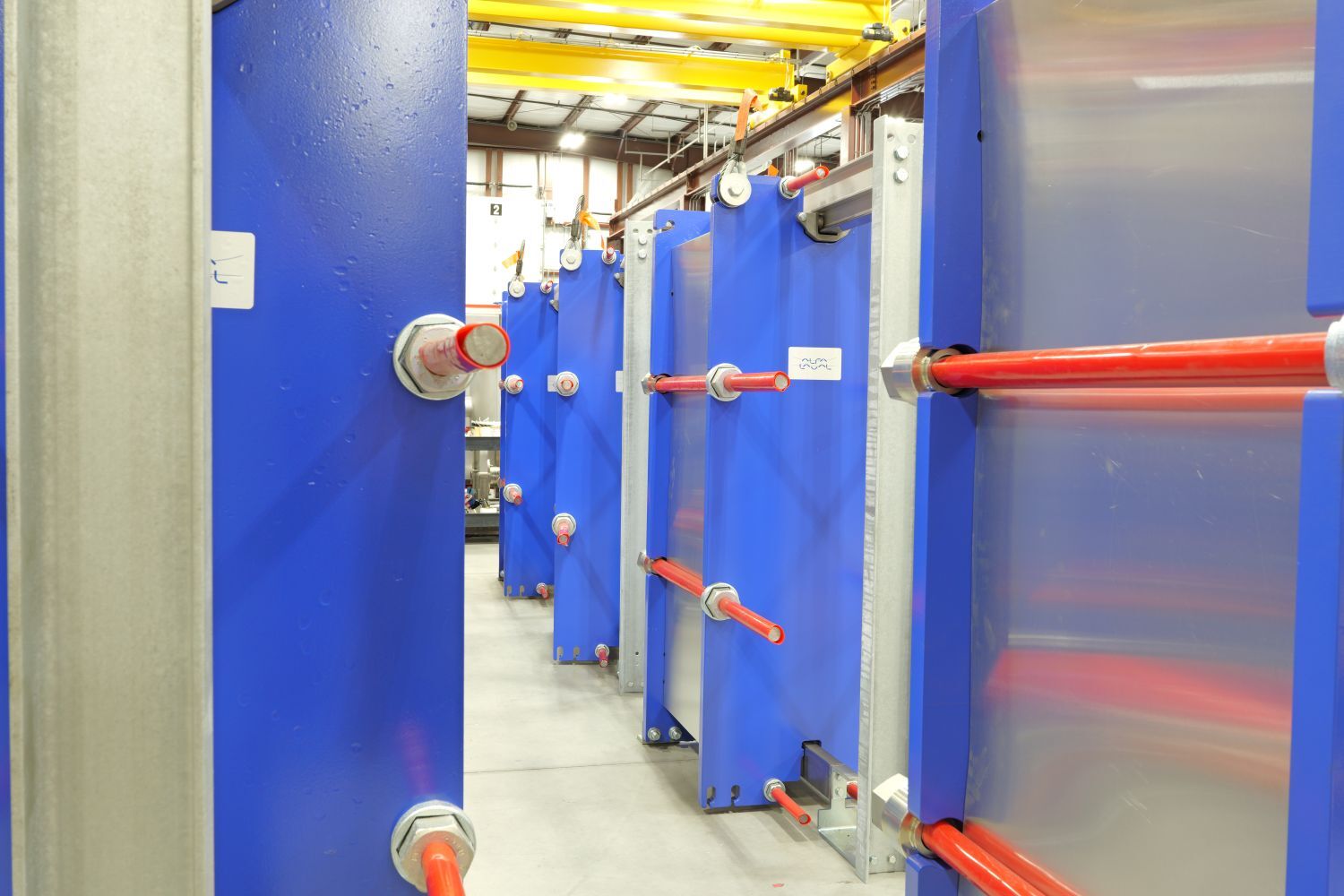
A plate heat exchanger is a compact, highly efficient heat-transfer device. The PHE transfers heat between two fluids using a stacked series of thin stainless-steel plates sealed with gaskets. These plates create alternating hot and cold flow channels, allowing for enormous heat transfer surface area/ volume ratios for highly efficient heat transfer. Because they offer exceptional performance in a compact and cost-effective design, PHEs are the most widely used heat exchangers for clean, low-viscosity fluids in industrial, HVAC, and hygienic applications like food, brewery, and biopharma processing.
What is a plate heat exchanger used for?
Plate heat exchangers are used for heating, cooling, heat recovery, and pasteurization in food, dairy, beverage, biopharma, HVAC, and industrial process applications.
How does a plate heat exchanger work?
A PHE works by routing hot and cold fluids through alternating plate channels, where heat transfers through the plate wall via conduction while turbulent flow maximizes efficiency.
Core components: Their Jobs
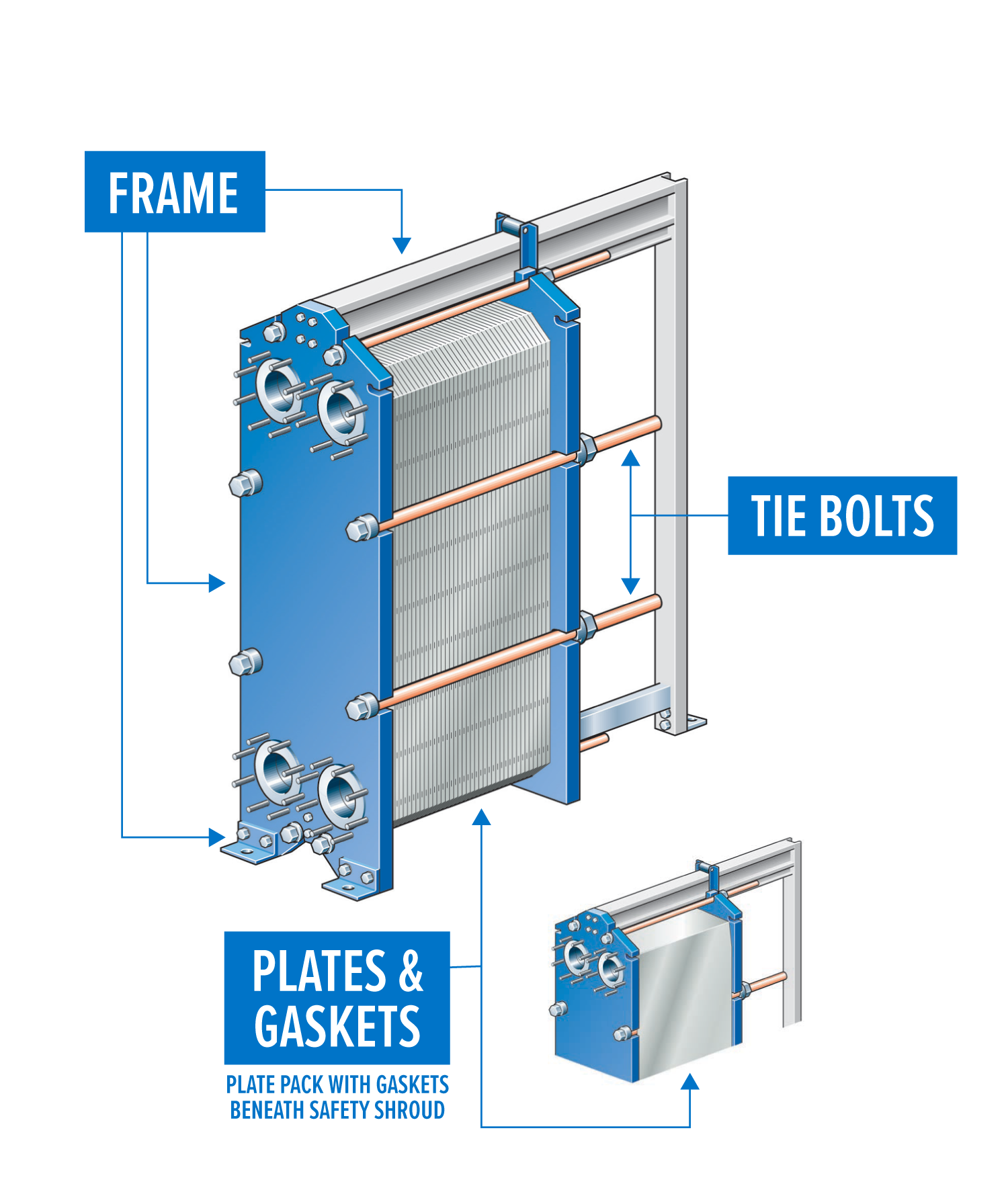
Plates — Thin stainless steel (often 316L) sheets pressed with a chevron (herringbone) pattern. The corrugations add strength and, more importantly, promote turbulent flow, which is critical for high heat transfer. Plate geometry (distribution channel design, chevron angle, spacing, and pressing depth) is tuned to balance heat transfer vs. pressure drop and to suit viscosity and fouling risk.
Gaskets — Elastomer seals that do two critical things: (1) seal the edges and ports to create the flow channels, and (2) route and separate each fluid into the correct alternating channels. Hygienic elastomers are commonly NBR or EPDM (FDA compounds available). NBR handles oils well; EPDM is strong with hot water/steam. FKM (Viton®) is for select harsh chemistries and high temps—not a blanket “upgrade” and is very rarely required in hygienic applications.
Frame — A fixed end (head) and movable pressure plate sandwich the plates, and upper and lower guide bars hold and align the plate pack. The frame carries the nozzles, sets the compression, and allows the unit to be opened for inspection, CIP, and maintenance. Frames range from painted CS with SS cladding to all‑stainless; sanitary heat exchanger frames typically use adjustable, elevated feet and open lower rails for easy plate handling and floor cleaning.
Tie (Compression) Bolts — Long, heavy bolts that draw the fixed head and pressure plate together to the specified plate‑pack dimension. Even cross‑pattern tightening protects plate integrity, uniformly compresses the gaskets, and keeps all components aligned for proper sealing and operation.
How it all works together for food and beverage processing
As the two fluids enter and fill the port distribution areas, gaskets shunt each stream into alternating plate flow channels. Corrugations create turbulent, chaotic flow conditions that accelerate heat transfer and improve cleanability. Heat is transferred from the hotter to the colder fluid across the conductive metal plate. In this manner, heat is transferred indirectly from one channel to the other while keeping the fluids separate. With dozens to hundreds of channels operating in parallel, a PHE can accommodate a large heat-transfer duty in a small footprint.
Plates, Patterns, and Pressure Drop
- Plate Shape — Narrower, longer plates allow for greater temperature changes from inlet to outlet but cause higher pressure drops compared to wider, squatter plates. The total surface area required is optimized based on plate shape and Chevron angle.
- Chevron Angle (Theta) — High-theta plates: higher turbulence and heat transfer, with more pressure drop. Low-theta plates: lower pressure drop and heat flux; you may need more plates to meet the duty. All high-theta, all low-theta, and mixed high and low configurations are common.
- Total Heat Transfer Surface Area — Total surface area required is optimized by configuring designs with different plate shapes and chevron patterns. It is dictated by duty, allowable pressure drop, and most efficient heat transfer.
- Corrugation Depth / Channel Gap — Wider flow channels reduce pressure drop and can accommodate viscous or particulate-bearing fluids. Deeper corrugation pressing depth decreases turbulence and reduces heat transfer efficiency. Special wide‑gap plates are available for highly viscous liquids and those containing fibers and large particulates, where traditional plate designs would not be suitable.
- Plate Thickness — Modern sanitary plates are commonly 0.5 mm (0.4 mm for light HVAC). Thinner plates lower resistance to heat transfer; thicker plates can extend life under punishing conditions but add cost and weight.
- Metallurgy — 304/316/316L are typical. For chlorides or aggressive media, Titanium, AL‑6XN®, and Hastelloy® C‑276® are options. Choice is driven by corrosion resistance, cleanability, availability, and total cost of ownership.
- Gasket Choice — It is critical to match the correct elastomer to the process fluid chemistry and temperature. FDA grades are typically required for food contact and are widely available. For most hygienic applications, NBR and EPDM are the only compounds to consider. Avoid the “FKM/ more expensive is always better” myth; it’s the right elastomer for the job that matters.
Advantages of Plate Heat Exchangers
- Higher heat transfer efficiency than shell-and-tube designs
- Smaller footprint and lower hold-up volume
- Easily expandable by adding plates
- Excellent cleanability for hygienic processes
Efficiency, cleanliness, and longevity—why precision matters
Plate heat exchangers deliver exceptional thermal performance in a compact, serviceable design that makes plate heat exchanger service accessible. Their efficiency comes from precision-engineered plates that balance turbulence, pressure drop, and cleanability. When properly specified, installed, and maintained, PHEs offer reliable, hygienic operation with minimal energy loss and downtime. Understanding how plate geometry, gasket selection, and frame design interact allows operators to optimize both process performance and long-term value—making the PHE a cornerstone of modern thermal systems across hygienic and industrial applications.
Plate Heat Exchanger FAQs
Expert Plate Heat Exchanger Service and Support
Keep your plate heat exchangers performing at their best with CSI’s expert service and support.
Contact Us to Schedule ServiceABOUT CSI
Central States Industrial Equipment (CSI) is a leader in distribution of hygienic pipe, valves, fittings, pumps, heat exchangers, and MRO supplies for hygienic industrial processors, with four distribution facilities across the U.S. CSI also provides detail design and execution for hygienic process systems in the food, dairy, beverage, pharmaceutical, biotechnology, and personal care industries. Specializing in process piping, system start-ups, and cleaning systems, CSI leverages technology, intellectual property, and industry expertise to deliver solutions to processing problems. More information can be found at www.csidesigns.com.