
Solving Downtime: How Redundant Cooling Eliminates Failures in Skid‑Based Data Centers
Modern data centers concentrate unprecedented heat loads into compact footprints. Cooling failures in high-density data centers can cause significant operational disruptions and financial losses, making redundant cooling infrastructure essential to maintaining uptime.
In modular, skid-based systems, redundant cooling is achieved by engineering backup pumps, heat exchangers, filters, and control paths so maintenance or a fault never compromises flow or thermal stability.
This article explains how redundancy is built into skid-mounted Cooling Distribution Units (CDUs), the architectures that eliminate single points of failure, and the operational practices that keep mission-critical cooling ready—supporting data center uptime, lowering downtime costs, and aligning with compliance expectations.
Importance of Redundant Cooling for Data Center Uptime
Cooling is not a comfort feature; it is mission-critical infrastructure. Thermal excursions can throttle compute, trigger protective shutdowns, or permanently damage hardware. Because the financial and reputational impacts of outages are severe, redundant cooling is a non-negotiable requirement in uptime-focused facilities and is commonly embedded in customer SLAs and audit frameworks.
Cooling systems in data centers are designed so they don’t shut down when something goes wrong. If an alarm occurs, the system keeps running while operators address the issue, because losing cooling isn’t an option. — Trent Bullock
Redundant cooling means designing systems with backup capacity and components—extra pumps, parallel heat exchangers, and failover controls—so any single failure or maintenance action does not interrupt service. In high-density environments, this architecture preserves data center uptime and minimizes thermal risk, directly mitigating losses highlighted in industry research.
Skid-Based Cooling Distribution Units in Modular Data Centers
Skid-based CDUs are prefabricated cooling assemblies mounted on steel frames that integrate pumps, valves, heat exchangers, sensors, filtration, expansion, and controls into one serviceable module. By relocating these CDUs into gray space—mechanical rooms, plant areas, or service corridors—operators free valuable white space, increase IT rack density, and improve service access without interrupting live aisles.
Benefits of skid-mounting include:
- Higher achievable redundancy through tightly integrated, parallelized components
- Modular maintenance through removable pump and heat exchanger assemblies that can be serviced off-skid in a workshop environment
- Scalable performance through variable-frequency pump control and modular skid deployment, allowing cooling output to match real-time server load while conserving energy
- Simplified logistics and rapid deployment compared with stick-built systems
- Enhanced lifecycle management aligned to modular data center cooling strategies
Redundancy Architectures in Skid Cooling Systems
Redundancy architecture is the strategic arrangement of backup components and paths to remove single points of failure. In skid-based systems, designers commonly implement N+1 and 2N models, with component-level backups at pumps, heat exchangers, filters, and controls. Because CDUs concentrate these assets in gray space, operators gain fault tolerance without sacrificing rack capacity. Typical structures include:
- N+1 within a skid: one standby pump, spare heat exchanger capacity, and redundant controls
- 2N skids: two fully independent CDUs and loops feeding the same load with automatic failover
- Distributed redundancy: multiple skids networked for load sharing and staged growth
N+1 and 2N Redundancy Models Explained
Mapping to reliability expectations often follows data center tier standards:
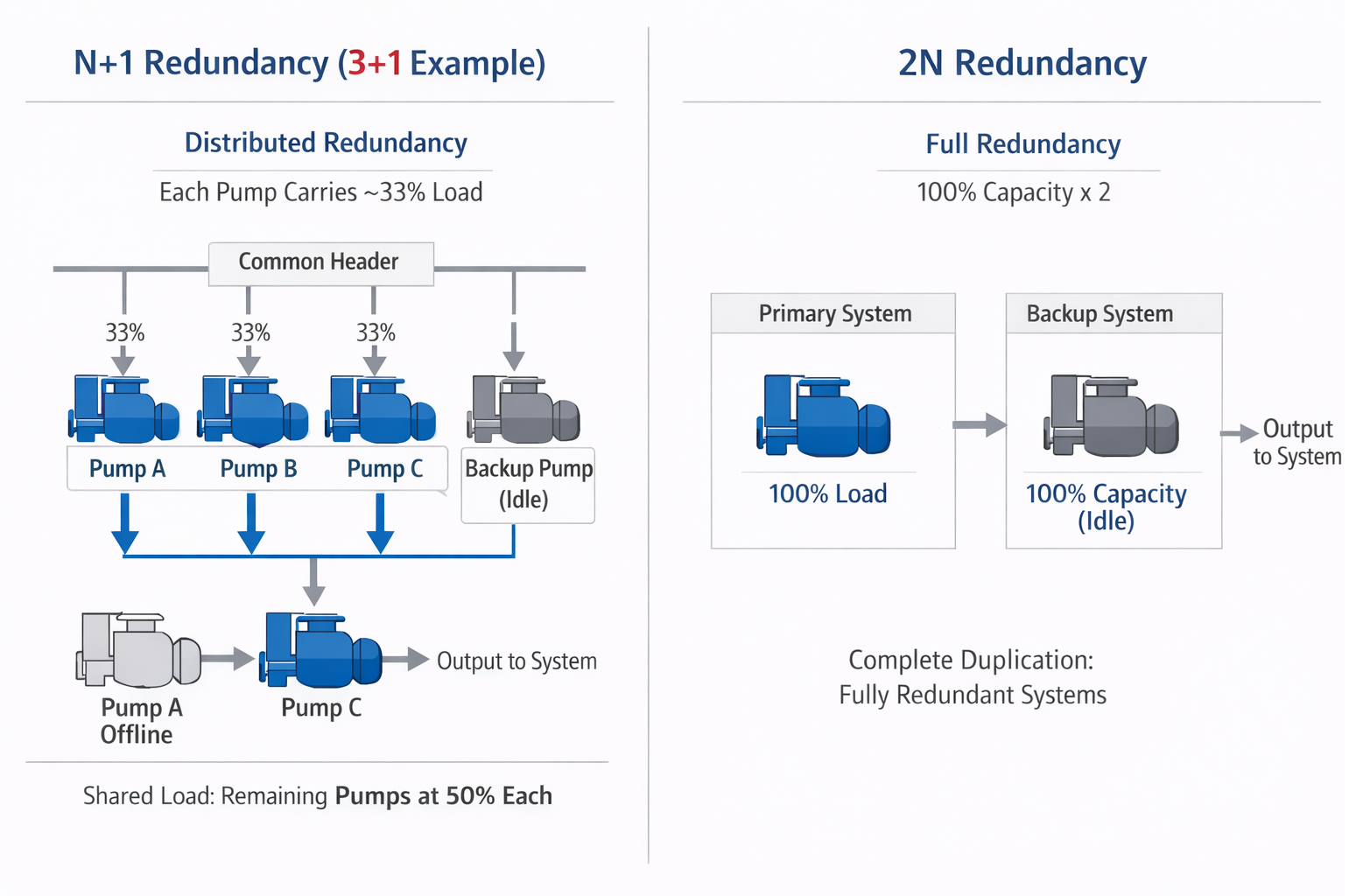
- N+1 Redundancy: The system includes one more component than needed for the design load (e.g., three pumps serving a two-pump duty). One component can be offline or fail with no loss of cooling. This is common in Tier III contexts and many enterprise facilities.
- 2N Redundancy: Two fully independent systems (power, pumps, controls, and loops), each capable of serving the full load. If one system fails, the other assumes 100% of the demand.
Trade-offs: N+1 balances cost and resilience, supports safe maintenance, and scales gracefully. 2N minimizes risk of correlated failures at higher capital and space costs, often favored in financial services, healthcare, and national security workloads.
| Mode 1 | Typical Application | Tier Alignment | Expected Availability |
| N+1 | Enterprise/colocation with high uptime and cost control | Tier III | ~99.82% (Uptime Institute tier standards) |
| 2N | Mission-critical and regulated industries needing maximum resilience | Tier IV | ~99.995% (Uptime Institute tier standards) |
Component-Level Redundancy: Pumps, Heat Exchangers, and Controls
In many skid CDU designs, redundancy is implemented at the module level. For example, systems may include multiple pump-and-heat-exchanger modules operating in an N+1 configuration, allowing a standby module to automatically take over if a component fails.
Many skid-mounted CDU systems implement redundancy at the module level rather than relying on a single oversized cooling train. For example, a skid may include multiple pump-and-heat-exchanger modules operating in an N+1 configuration, with four active modules supporting the cooling load and a fifth available as a standby. Each module contains its own pump, heat exchanger, filtration, and instrumentation, allowing the control system to automatically switch to the standby module if a fault occurs or a component requires maintenance. Additional redundancy is often built into sensors, controls, and communications so that a failure in a single device does not interrupt cooling operation.
In our skid design, we run four cooling modules and keep a fifth in reserve. If a pump, heat exchanger, or sensor fails, the system can automatically switch to the standby module and keep the cooling loop operating. — Trent Bullock
Uptime depends on eliminating common failure points:
- Pumps: Duty/standby or parallel pumps with auto-changeover and isolation enable hot-swappable maintenance; this approach is standard in high-density cooling. Understanding how to read a pump curve helps engineers select appropriately sized units for redundant configurations.
- Heat exchangers: Parallel plate packs or modular cores allow isolation and service without stopping flow.
- Filters/strainers: Redundant filtration paths with dedicated filters for each cooling module help maintain flow and reduce fouling risk without interrupting service.
- Controls and power: Redundant PLCs/controllers, independent sensor strings, dual power feeds, and watchdog failover maintain control logic and failover functionality.
Hot swap means removing and replacing a component while the system remains running, enabled by isolation valves, check valves, and smart controls. Skid CDUs provide dense, accessible layouts that simplify parallel and standby configurations.
Best Practices for Maintaining Redundant Skid Cooling
Redundancy only works if it stays ready. Idle backups that are never exercised can become the weakest link. Stagnant zones—dead legs—accelerate corrosion, fouling, and microbiological growth, reducing heat transfer and threatening reliability. Establish documented SOPs that incorporate coolant health monitoring, proactive industrial maintenance, and downtime prevention into the PM calendar.
Periodic Circulation and Water Treatment to Prevent Fouling
Dead legs are piping segments with little to no routine flow, making them hotspots for corrosion and biofouling. Best practices include:
- Periodic circulation of redundant loops and components on a defined interval
- Automated bypass lines and valve sequences to ensure minimum flow through idle assets
- Side-stream filtration and continuous monitoring of differential pressure
- Water chemistry control (corrosion inhibitors, biocide programs, pH, and hardness control)
- Routine trending of conductivity, iron/copper levels, and microbiological activity
The cost of disciplined water treatment and routine circulation is marginal compared to the financial impact of degraded heat transfer and potential downtime
Pump Redundancy and Modular Service Design
Multiple pumps with at least one standby unit ensure continuous cooling during maintenance or unexpected failures. In an N+1 configuration, the standby pump automatically assumes duty if an operating pump is taken offline or experiences a fault, maintaining flow and thermal stability.
When maintenance is required, technicians isolate the affected pump or module using valves while the redundant unit continues operating. The component can then be removed for service and maintenance, or replacement, without interrupting the cooling loop. After repairs are completed and the module is reinstalled, the system returns to its normal duty/standby rotation.
This modular approach reduces mean time to repair and allows technicians to service equipment in a controlled maintenance environment rather than performing complex repairs directly within the skid. In skid-based CDU designs, redundancy and modular serviceability work together to maintain cooling availability while enabling routine maintenance and component replacement.
Continuous Monitoring and Intelligent Controls Integration
Intelligent controls are automated systems that monitor temperature, flow, pressure, and pump status in real-time; they adjust setpoints, initiate failover, and support remote access. Each skid operates with its own control system, while plant-level process monitoring systems can aggregate performance data and operational status from multiple skids across the facility. Recommended practices:
- Many facilities monitor coolant chemistry and particulate levels through plant-wide water treatment programs and maintenance SOPs.
- Use automated alarming, trend analytics, and predictive thresholds.
- Periodically test failover logic and simulate sensor faults to verify the response.
Commissioning and Load Testing for Reliable Failover
Commissioning should simulate real operating conditions to validate every redundant path. Include staged GPU/server ramp profiles, maximum expected heat loads, and transient scenarios such as pump trips or valve failures. Instrument racks to track temperatures, pressures, and flows, and correct imbalances before they become hotspots. A pragmatic checklist (adapted from industry guidance) includes connectivity and failover logic testing, load and thermal simulations, and baseline data capture for future comparison.
CDU skids typically undergo factory acceptance testing (FAT) to verify flow paths, instrumentation, and failover logic as part of rigorous quality assurance protocols. Full commissioning occurs at the data center facility once the system is connected to servers, cooling towers, and real operating conditions.
Business Case for Redundant Cooling in Skid-Based Data Centers
Even a single avoided outage can justify the cost of adding redundant cooling components. Incremental costs for circulation, robust water treatment, pump redundancy, and intelligent monitoring are small compared with the costs of thermal events that jeopardize equipment. Benefits include:
- Maximized uptime and consistent service delivery
- Reduced unscheduled interventions and safer maintenance windows
- Extended asset life via clean, well-conditioned loops
- Stronger audit performance and lower data center total cost of ownership
Example: Preventive measures (chemical control, filtration media, periodic loop exercise, and sensor calibration) may cost in the low five figures annually, while a single cooling-related outage can eclipse that by orders of magnitude—before accounting for customer credits or hardware damage. CSI delivers turnkey, hygienic, skid-based fluid systems tailored to these outcomes, from design and fabrication through commissioning and lifecycle support. Our data center racks, coolant manifolds, and precision fittings are engineered using 304 vs 316 stainless steel selected for each application, with passivation of stainless steel processes ensuring long-term corrosion resistance.
FAQs
Prevent downtime before it starts.
Partner with CSI for modular CDU skids and redundant cooling systems designed for continuous data center operation.
Contact a Data Center ExpertABOUT CSI
Central States Industrial Equipment (CSI) is a leader in distribution of hygienic pipe, valves, fittings, pumps, heat exchangers, and MRO supplies for hygienic industrial processors, with four distribution facilities across the U.S. CSI also provides detail design and execution for hygienic process systems in the food, dairy, beverage, pharmaceutical, biotechnology, and personal care industries. Specializing in process piping, system start-ups, and cleaning systems, CSI leverages technology, intellectual property, and industry expertise to deliver solutions to processing problems. More information can be found at www.csidesigns.com.