
Heat Exchangers in Brewing: Essential Equipment for Modern Breweries
The difference between exceptional beer and a mediocre product in the brewing industry often comes down to temperature control. While brewers focus intensely on ingredient quality and fermentation management, one piece of equipment quietly ensures that hot wort transforms into perfect beer: the heat exchanger. These critical systems enable rapid cooling from near-boiling temperatures to optimal fermentation conditions, preventing off-flavors while dramatically improving production efficiency.
In brewing, consistency is everything—and that starts with thermal precision. A high-quality heat exchanger doesn’t just cool wort quickly; it safeguards flavor, boosts efficiency, and supports sustainable production.

Why Breweries Need Heat Exchangers
The brewing process demands precise thermal control at multiple critical stages, making heat exchangers essential equipment for any modern brewery. The most crucial application occurs immediately after the boil, where hot wort must be cooled rapidly to prevent the formation of dimethyl sulfide (DMS). This compound creates undesirable off-flavors reminiscent of cooked corn or vegetables.
Without proper heat exchange, wort cooling could take several hours using traditional methods, creating an extended window for bacterial contamination. Modern heat exchangers reduce this vulnerable period to less than 45 minutes for large batches, dramatically improving both product safety and quality consistency.
The cooling process also presents an excellent opportunity for energy recovery. Heat extracted from the hot wort doesn’t simply disappear—it’s transferred to cold water flowing on the reverse side of the heat exchange system. This heated water can then be used for cleaning operations, the next brew cycle, or other brewery processes, creating significant operational cost savings.
Cooling Times
Reducing cooling time from hours to 45 minutes or less
Faster Production Cycles
Enabling higher brewery throughput with faster production
Reduced Labor
Lowering labor commitment during cooling phases
Consistent Temperature
Keeping control temperatures consistent across a batch
Sustainability
Recycling water for cleaning, preheating, and other functions, lowering operating costs
Types of Heat Exchangers Used in Brewing
Breweries most commonly use gasketed plate-and-frame heat exchangers and shell-and-tube heat exchangers, each suited to different needs.
Plate heat exchangers are generally preferred for their high thermal efficiency, compact design, and ease of cleaning, making them ideal for most brewery sizes and for rapid wort cooling before fermentation.
Shell-and-tube heat exchangers, while less common in brewing, can be a good fit for high-volume operations, applications requiring extreme durability, or situations with challenging particulates or viscosities. However, they typically have lower heat transfer efficiency and require more space compared to plate designs.
The new Hygienic WideGap Plate Heat Exchanger from Alfa Laval addresses many of the limitations traditionally associated with shell-and-tube designs, offering greater efficiency and easier maintenance without sacrificing durability. Contact us to find the right heat exchanger for your specific processing requirements.
Design Considerations for Brewery Heat Exchangers
Choosing the right heat exchanger for brewing operations involves evaluating material compatibility, system capacity, and thermal efficiency. These decisions directly affect product quality, sanitation, energy use, and the brewery’s ability to scale production. Below are key design factors grouped by category.
Material Selection & Sanitary Design
- Use food-grade stainless steel (304 or 316) for all wetted surfaces
- Ensure compatibility with acidic wort and cleaning chemicals
- Support Clean-In-Place (CIP) for hygiene and efficiency
- Consider Hastelloy or other premium alloys for corrosive environments
- Double-wall plate designs help prevent cross-contamination from leaks
Sizing, Capacity & Flow Efficiency
- Size based on: max batch size and daily throughput, cooling water temp/flow rate, desired temperature drop and cooling time, and heat recovery goals
- Counterflow configurations optimize thermal efficiency
- Oversizing allows future expansion, but increases upfront cost
- Undersizing can restrict production and create bottlenecks
Brewery Heat Exchangers
CSI is your trusted source for hygienic processing equipment.
Explore Our Heat Exchangers for BreweriesHeat Exchanger Applications in Beer Production
Critical Equipment
Heat exchangers are critical to brewing operations well beyond wort cooling. From energy recovery to final product conditioning, these systems support thermal control across nearly every stage of production. Efficient heat exchange not only improves product quality and consistency but also enables breweries to reduce energy consumption and streamline cleaning processes.
By recovering heat during wort cooling and repurposing it for tasks like mashing or cleaning, breweries can cut energy use by up to 40%. Additionally, precise thermal control during fermentation and final packaging ensures optimal yeast performance, carbonation, and shelf stability.
Brewery Applications
- Primary wort cooling
- Heat recovery
- Preheating water for mashing operations
- Providing hot water for cleaning and sanitation
- Supporting pasteurization processes
- Heating other process streams
- Temperature control during fermentation
- Final product processing
Maintenance and Operational Excellence
Effective maintenance programs are crucial for maximizing heat exchanger performance and extending equipment life in brewery environments.
Clean-In-Place (CIP) Procedures
Regular CIP cycles remove organic deposits, hop residues, and mineral buildup that can harbor bacteria and reduce heat transfer efficiency. Typical CIP protocols include caustic cleaning, acid cleaning, and sanitization.
Manual Inspection and Maintenance
Disassemble plate heat exchangers following good manufacturing processes (as often as every 10 brews or quarterly) to inspect plates for damage, corrosion, or wear, verify sealing, and replace deteriorating gaskets.
Performance Monitoring
Regular monitoring—such as temperature monitoring, flow rate verification, pressure drop measurements to detect fouling, and energy consumption tracking—helps identify potential issues before they impact production.
Energy Efficiency & Cost Benefits
Modern heat exchangers deliver substantial economic benefits that extend far beyond their initial purchase price, making them crucial investments for competitive brewing operations.
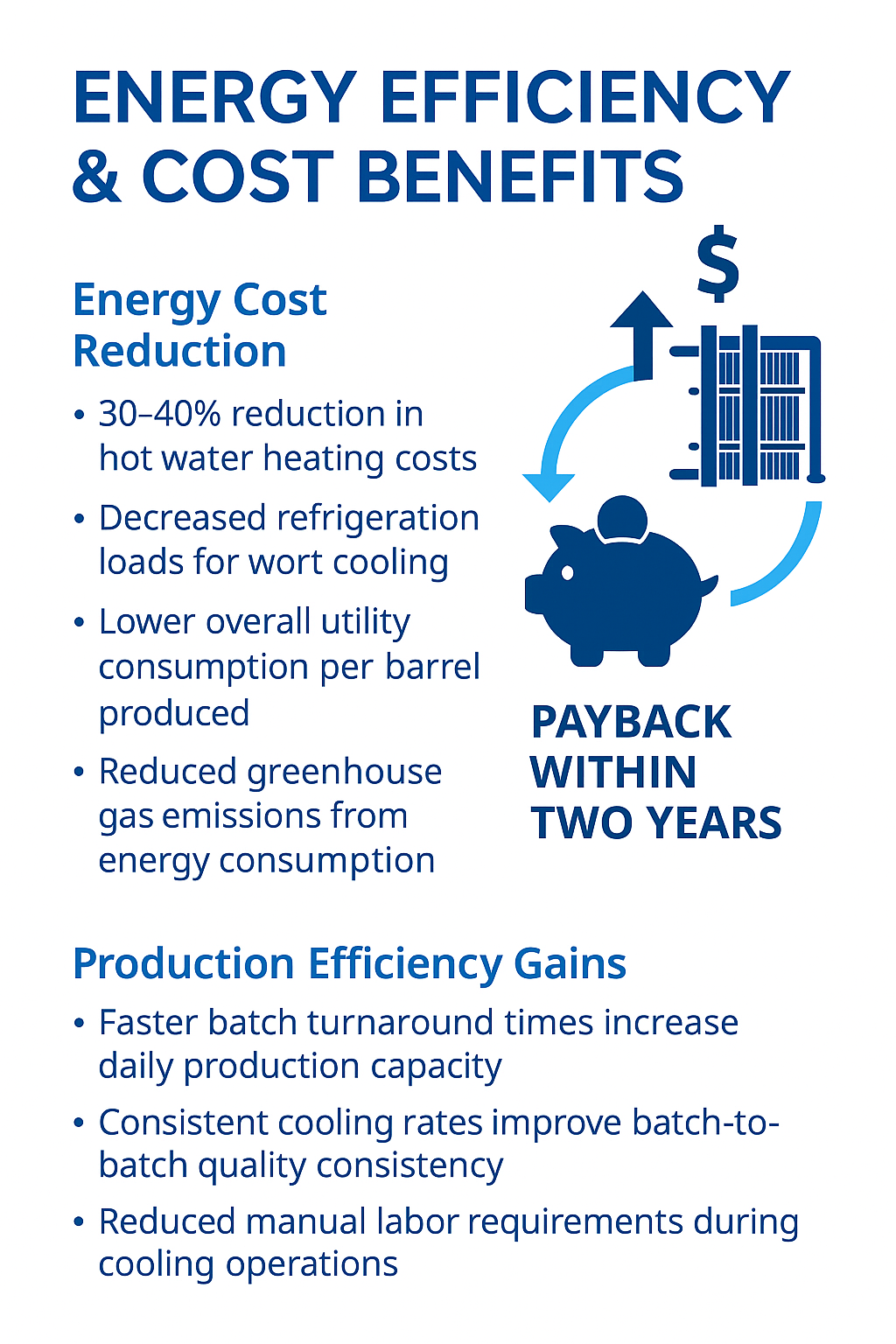
High-quality heat exchange systems typically achieve payback within two years through combined energy savings, production improvements, and quality benefits. This rapid payback makes heat exchanger upgrades attractive investments for breweries seeking to improve competitiveness.
Energy Cost Reduction
The most significant ongoing benefit comes from energy recovery during the cooling process. Instead of simply rejecting heat to the environment, efficient systems capture this thermal energy for reuse throughout the brewery.
Typical energy savings include:
- 30-40% reduction in hot water heating costs
- Decreased refrigeration loads for wort cooling
- Lower overall utility consumption per barrel produced
- Reduced greenhouse gas emissions from energy consumption
Production Efficiency Gains
Beyond direct energy savings, heat exchangers enable operational improvements that boost overall brewery profitability:
- Faster batch turnaround times increase daily production capacity
- Consistent cooling rates improve batch-to-batch quality consistency
- Reduced manual labor requirements during cooling operations
- Minimized product loss from contamination or quality issues
Common Challenges and Solutions
Challenge: Fouling and Cleaning Challenges
Hop matter, proteins, and minerals can rapidly accumulate on heat transfer surfaces, reducing efficiency and creating contamination risks.
Solutions include:
- Optimized CIP procedures
- Regular backflushing at 150% normal flow rates to remove solid deposits
- Preventive maintenance schedules based on production volume
- Water treatment to minimize mineral deposition
Challenge: Material Compatibility Issues
Exposure to acids, cleaning chemicals, and thermal cycling can degrade gaskets and seals, making material selection integral.
Solutions include:
- Careful gasket material selection for chemical compatibility
- Regular inspection and replacement schedules
- Spare parts inventory for quick repairs
- Training for maintenance personnel on proper procedures
Challenge: Flow Distribution Problems
Poor plate design or installation can create uneven flow patterns that reduce efficiency and create hot spots.
Solutions include:
- Proper engineering analysis during system design
- Correct plate pattern selection for specific applications
- Regular flow verification and system balancing
- Professional installation and commissioning
Heat Exchanger Applications in Brewing and Cider Production
Heat exchangers play a vital role across the brewing and cider-making process—from rapid wort cooling to fermentation control and final product conditioning. They also enable energy recovery by capturing heat during wort cooling and repurposing it for mashing, cleaning, or other thermal processes, reducing energy costs and improving sustainability.
Ready to Optimize Your Brew?
Whether you're scaling production or fine-tuning quality, the right heat exchanger can make all the difference. Talk to our experts today to find a hygienic, energy-efficient solution tailored to your brewery or cidery.
Hygienic Heat Exchangers Sales and Service
Whether you’re scaling up production or optimizing existing systems, our team offers expert sales and service for brewery and cider heat exchangers.
Contact us today to get started.ABOUT CSI
Central States Industrial Equipment (CSI) is a leader in distribution of hygienic pipe, valves, fittings, pumps, heat exchangers, and MRO supplies for hygienic industrial processors, with four distribution facilities across the U.S. CSI also provides detail design and execution for hygienic process systems in the food, dairy, beverage, pharmaceutical, biotechnology, and personal care industries. Specializing in process piping, system start-ups, and cleaning systems, CSI leverages technology, intellectual property, and industry expertise to deliver solutions to processing problems. More information can be found at www.csidesigns.com.