
304 vs 316 Stainless Steel for Processing Systems
Stainless steel is the preferred choice for hygienic processing systems across the food, dairy, beverage, and pharmaceutical industries because of its remarkable corrosion resistance, durability, and cleanability. These traits ensure compliance with rigorous sanitation standards while withstanding the harsh conditions prevalent in processing environments, which often involve acids, cleaning agents, and extreme temperatures (up to 1500°F for 304 and 316 stainless steel). The most frequently utilized stainless steels in these fields are 304 and 316, with 316's molybdenum content offering enhanced resistance to acid corrosion.


Differences Between 304 and 316 Stainless Steel
Choosing the appropriate grade of stainless steel is critical for a processing system's durability, cleanliness, and chemical resistance. While 304 and 316 stainless steels belong to the austenitic family and offer strong corrosion resistance, their differences greatly influence their suitability for different processing applications.
A key difference between the two grades of stainless steel lies in their corrosion resistance. 316 stainless steel includes molybdenum, generally around 2-3%, which boosts its resistance to corrosion, which causes pitting and crevice corrosion. This characteristic makes 316 ideal for environments with high exposure to salts, acids, and aggressive cleaning agents, such as food, dairy, beverage, and pharmaceutical processing. Conversely, 304 stainless steel, lacking molybdenum, is more vulnerable to corrosion in acidic settings.
Additionally, 316 stainless steel offers slightly greater tensile strength and superior heat resistance, which is better suited for high-temperature applications. However, this enhanced performance comes at a higher cost than 304. For systems that don't face harsh chemicals or elevated salinity, 304 stainless steel remains a cost-effective and durable alternative.
Choosing between 304 and 316 stainless steel depends on the specific demands of the application. For general sanitary processing where exposure to aggressive chemicals is minimal, 304 may be sufficient. However, 316 provides better long-term reliability in harsher environments, reducing the risk of corrosion-related failures and costly downtime.
Chemical Composition and Mechanical Properties
The chemical composition of stainless steel influences its resistance to corrosion, strength, and adaptability. Both 304 and 316 grades are austenitic, characterized by their high chromium and nickel content, which aids in corrosion resistance and formability. The added nickel increases the strength and gives the steel its high temperature and oxidation resistance. Notably, 316 stainless steel contains molybdenum, which significantly improves its overall strength and protection against corrosion.
Chemical Composition
- 304 Stainless Steel: Composed of approximately 18-20% chromium and 8-10.5% nickel, 304 stainless steel provides excellent corrosion resistance and versatility. It is widely used in food processing, beverage, and dairy applications due to its ease of cleaning and ability to withstand mild acids and alkaline solutions.
- 316 Stainless Steel: Contains 16-18% chromium, 10-14% nickel, and 2-3% molybdenum. Adding molybdenum improves corrosion resistance, making 316 ideal for harsher environments such as biopharmaceutical and other high-purity processing applications.
Mechanical Properties
- 304 Stainless Steel is recognized for its high durability and exceptional formability. It's commonly used in structural applications where moderate strength and corrosion resistance are essential. Its ease of welding and fabrication makes it a preferred option for complex components.
- 316 Stainless Steel: Provides excellent mechanical strength and heat resistance, which makes it ideal for high-temperature or highly corrosive settings. Its molybdenum content enhances its resistance to stress corrosion cracking, guaranteeing long-term dependability in challenging processing environments.
Corrosion Resistance in Food & Pharmaceutical Processing
Corrosion resistance is essential in processing food, beverages, dairy products, pharmaceutical processing, and the clean-in-place process. Over time, materials can deteriorate due to cleaning agents, acidic substances, and high temperatures, making the selection of suitable stainless steel crucial for ensuring long-lasting performance.
Stainless Steel Benefits in Processing
316 Stainless Steel Benefits
- Superior Corrosion Resistance – Withstands exposure to strong acids, alkalis, and saltwater, reducing equipment degradation.
- Ideal for High-Purity Applications – Used in pharmaceutical, biotech, and food processing where hygiene and contamination prevention are crucial.
- Resistance to Pitting and Crevice Corrosion – Performs well in CIP (Clean-in-Place) systems with harsh chemicals.
- Use Cases – Built for more challenging conditions, like pharmaceutical production, biotech labs, and acidic food processing.
304 Stainless Steel Benefits
- Cost-Effective Option – This material is more affordable than 316, making it a budget-friendly choice for processing systems.
- Adequate Corrosion Resistance – It withstands oxidation and mild acids, making it appropriate for various standard food and beverage processing applications.
- Use Cases – Great for everyday food and beverage processing, such as brewing tanks and dairy pipelines.
Aesthetic Appeal and Surface Finish Options
Stainless steel is valued for its strength, corrosion resistance, aesthetic appeal, and surface finish options, which are essential in hygienic processing environments, where industry-standard 3A fittings typically have a 32RA ID/OD. The right surface finish improves cleanability, reduces the risk of microbial contamination, and enhances the material's durability in food, beverage, and pharmaceutical applications.
Two of the most common finishes used in, especially in biopharmaceutical processing systems, are:
SF1 (Mechanical Polish)
SF1 is a standardized surface finish designation for stainless steel, defined by the ASME BPE (Bioprocessing Equipment) Standard. It specifically refers to a mechanically polished surface with a defined surface roughness value.
SF4 (Electropolish)
SF4 is a standardized surface finish designation according to the ASME BPE (Bioprocessing Equipment) Standard, specifically referring to an electropolished surface on stainless steel.
Applications of 304 and 316 Stainless Steel in Processing
Both 304 and 316 stainless steel are extensively utilized in various processing industries, but their specific applications vary based on distinct corrosion resistance, chemical exposure, and environmental conditions. Selecting between 304 and 316 stainless steel hinges on particular processing requirements, exposure to corrosive materials, and regulatory standards for hygiene and safety.
Applications of 304 Stainless Steel
- Food and Beverage Equipment – Used in tanks, piping, and heat exchangers where moderate corrosion resistance is sufficient
- Example – 304 Stainless Steel is commonly used in dairy pipelines and brewery fermenters, where oxidation resistance and mild acids are sufficient for safe processing.
Applications of 316 Stainless Steel
- Chemical Processing – Due to its superior corrosion resistance, it is better suited than 304 for environments exposed to acids or harsh cleaning chemicals. However, like 304, it will succumb to corrosion cracking when exposed to chlorides.
- Pharmaceutical and Biotechnology Equipment – Used in ultra-pure processing environments where preventing contamination is critical.
- Example – 316 Stainless Steel is the material of choice for pharmaceutical reactors and biotech storage tanks, ensuring reliability in highly controlled environments.
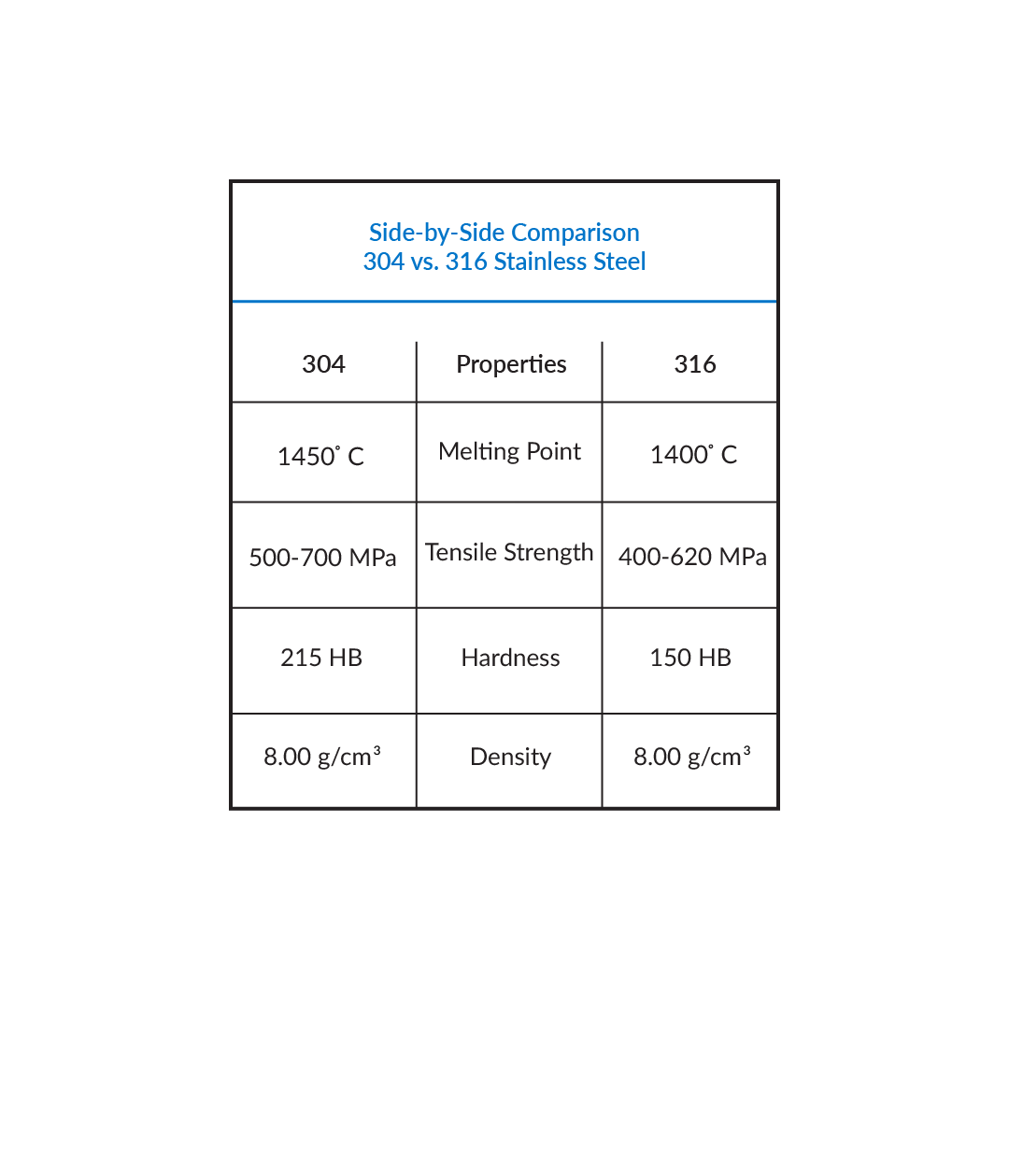
Cost Considerations and Heat Resistance
Cost Comparison
- Due to its higher nickel and molybdenum content, 316 stainless steel is typically 30-40% more expensive than 304.
- The added cost is justified for applications involving harsh chemicals or extreme conditions, where 316's superior corrosion resistance prevents premature equipment failure and reduces long-term maintenance costs.
- 304 stainless steel remains the more cost-effective choice for applications that do not require high resistance to acids, making it widely used in standard food and beverage processing.
Heat Resistance
- 304 and 316 stainless steel offer an oxidation threshold of 1500°F.
- 316 stainless steel is perfect for sterilization procedures, autoclaves, and food or pharmaceutical applications requiring prolonged heat exposure (up to the threshold of 1500°F) without risking material integrity.
Choosing 304 vs 316 Stainless Steel
Selecting the appropriate stainless steel grade ensures system durability, cleanliness, and processing efficiency. Factors such as corrosion resistance, mechanical strength, and affordability influence the ideal choice. Careful assessments of processing conditions and material performance maintain optimal system reliability, hygiene, and long-term cost savings.
- Corrosion Resistance – Consider the exposure to cleaning agents, acids, and process fluids that may cause degradation over time.
- Mechanical Properties – Verify that the material has sufficient strength and durability for structural elements and high-pressure uses.
- Cost-Effectiveness – Evaluate the upfront cost in terms of long-term maintenance requirements, particularly in settings with significant chemical exposure.
- Use – Consider materials to be processed, temperature requirements, and standard CIP processes for the product.
FAQs
- What is the main difference between 304 and 316 stainless steel?
-
The main difference is that 316 stainless steel includes molybdenum (2-3%), which increases strength and improves corrosion resistance in acidic conditions. In contrast, 304 stainless steel is more affordable but less resistant to harsh chemicals and salt exposure.
- When should I choose 316 stainless steel over 304?
-
316 stainless steel is preferred over 304 in more acidic environments due to its enhanced corrosion resistance, thanks to the addition of molybdenum. 304 stainless steel is adequate for general food, dairy, and beverage processing.
- How does surface finish impact stainless steel performance in hygienic applications?
-
Polished finishes, such as SF1 (mechanical polish) and SF4 (electropolish), improve the surface finish and reduce surface roughness.
- Why is stainless steel substantial in Clean-in-Place (CIP) systems?
-
CIP systems use strong alkaline and acidic cleaning solutions, which can degrade materials over time. 316 stainless steel is highly resistant to these chemicals, reducing system maintenance and extending equipment lifespan.
- Is the higher cost of 316 stainless steel worth it?
-
Yes, for harsh processing environments. While 316 stainless steel is 30-40% more expensive than 304, it prevents corrosion-related failures, reduces maintenance costs, and extends equipment life, making it a cost-effective investment for high-purity and chemical-intensive applications.
- Does CSI offer stainless steel solutions for my industry?
-
Absolutely! CSI specializes in hygienic processing systems for food, beverage, dairy, data center cooling, pharmaceutical, and biotech industries, offering high-quality 304, 316, AL-6XN®, and Hastelloy® C-22® stainless steel solutions. Contact CSI for expert guidance on your processing system needs!
ABOUT CSI
Central States Industrial Equipment (CSI) is a leader in distribution of hygienic pipe, valves, fittings, pumps, heat exchangers, and MRO supplies for hygienic industrial processors, with four distribution facilities across the U.S. CSI also provides detail design and execution for hygienic process systems in the food, dairy, beverage, pharmaceutical, biotechnology, and personal care industries. Specializing in process piping, system start-ups, and cleaning systems, CSI leverages technology, intellectual property, and industry expertise to deliver solutions to processing problems. More information can be found at www.csidesigns.com.